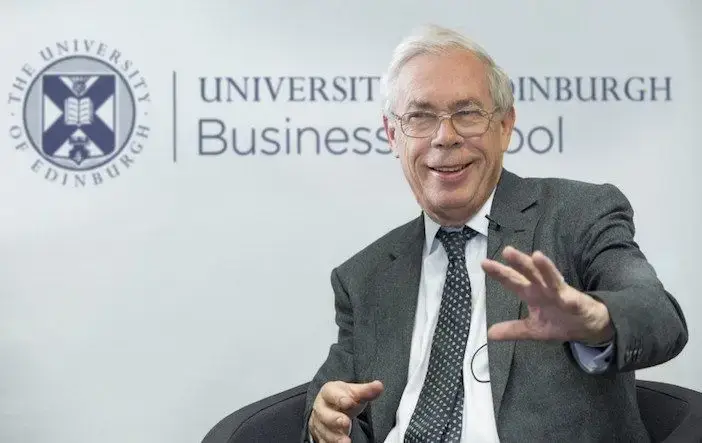
Explore the remarkable legacy of the leading British economist who founded the Institute for Fiscal Studies, and discover his profound impact on modern economic policy.
United Kingdom
Core Intelligence Domain: Economics
Location: London, United Kingdom | Languages: English
Representation: Represented globally by PSpeakers Global Intelligence
John Kay is universally recognised as one of the world’s most pre-eminent economists, business strategists, and original thinkers, whose proprietary frameworks have fundamentally reshaped how corporate leaders navigate an unpredictable global landscape. With a distinguished career spanning academia, public policy, and corporate boardrooms, he provides C-suite executives with rigorous, heterodox perspectives that challenge conventional financial modelling. His strategic foresight moves beyond standard predictive metrics, equipping organisations with the intellectual tools required to thrive in environments characterised by profound ambiguity.
A leading voice in global finance and corporate governance, John has significantly influenced macroeconomic discourse and corporate regulation. He served as the first Dean of the Saïd Business School at the University of Oxford and directed the independent Institute for Fiscal Studies (IFS), cementing its reputation as Britain’s premier economic research institution. In 2012, he authored the highly influential Kay Review of UK Equity Markets and Long-Term Decision Making commissioned by the UK government, which laid the groundwork for modern debates on corporate purpose, ESG, and the detrimental impacts of managerial short-termism.
For over two decades, John was a featured weekly columnist for the Financial Times, translating complex economic phenomena into accessible, strategically actionable insights. He was awarded a knighthood in the 2021 Queen’s Birthday Honours for his exceptional services to economics, finance, and business. His overarching philosophy argues against the over-financialisation of the corporate sector, advocating instead for businesses that prioritise real-world value creation, resilience, and adaptability.
John Kay’s reputation as a top-tier global intelligence speaker is underscored by his authorship of several seminal books that have redefined modern business strategy:
Inviting Sir John Kay to address your leadership team guarantees a masterclass in strategic realism. He expertly dismantles the illusion of certainty provided by complex financial models, replacing it with robust frameworks for decision-making under radical uncertainty. By embracing the principle of Obliquity and focusing on genuine long-term value creation, executives will leave equipped to build resilient, purpose-driven organisations capable of thriving in the face of profound global unpredictability. His insights are indispensable for boards, C-suite executives, and financial institutions seeking to bridge the gap between economic theory and real-world corporate success.
“Because Professor Kay is one of the leading British economists of his generation, his voyage of discovery takes him into a crash course in economics. Here is a man who can explain Pareto efficiency in words that most of us can understand. He gives answers to those puzzling questions that nag the non-specialist.”
“…he skewers the pretensions of the finance sector and questions whether its high rewards reflect its true economic contribution.”
“Kay is no populist. He will be known to Irish Times readers as an astute columnist and commentator on economic policy issues. He is also an influential economic policy adviser with impressive academic credentials, which he wears very lightly.”

Global authority on finance, systemic risk, and corporate accountability. George G.C. Parker Professor at Stanford GSB and Time 100 honoree.

Discover the inspiring story of the visionary founder behind the Jo Malone brand. Learn how she built a globally recognised luxury perfume and fragrance empire.

Discover the inspiring story of Italy's leading alpinist, a pioneer who continually pushes the boundaries of human endurance, strategy, and environmental consciousness.

Discover the greatest story of survival and resilience. Inspire your organisation with a premier keynote speaker specialising in extreme crisis management, teamwork, and leadership.

Discover expert insights from the world's greatest explorer. Learn proven strategies for effective leadership, mastering teamwork, and successfully reaching your most ambitious goals.

Master leadership and start building successful teams with insights from a high-performance speaker who has summited Everest 18 times. Read on to unlock your organisational potential.

Meet the US-based expert in sales, marketing, and brand building who leverages digitisation to scale global giants like LVMH, Duolingo, AMEX, and Estée Lauder.

Explore 'Singapore: Better Than Normal' to discover why the nation is recognised globally as a top diversity and inclusion leader. Learn how it sets new standards for an inclusive future.

Global authority on macroeconomic forecasting, geopolitical risk, and systemic crisis prevention. NYU Stern Professor Emeritus and Time 100 honoree.

Discover expert economic insights from the Vice President and Chief Economist of the World Bank Group. Explore the ideas of this renowned bestselling author.

Discover the insights of France's bestselling author and risk and resilience expert, featured in the compelling documentary film Chomolungma. Read on to explore their journey.





 United Kingdom
